Halal Food — General Requirements
Adopted and localised version of MS 1500:2019 (Third revision), applied to the Democratic Republic of Timor-Leste.
Introduction ↑ Top
Halalan toyyiban are two Arabic words found in several surahs of the Quran. One of them is Surah al-Baqarah, verse 168: "O people! Eat of what is on earth, lawful and good, and do not follow the footsteps of the evil one, for he is to you an avowed enemy."
Halalan toyyiban encompasses several elements. Halal foods and beverages, and both their sources, shall be obtained from a halal source, accepted by nature (fitrah), free from doubt (not syubhah), clean, safe and nutritious. The concept also covers preparation, processing and storage of consumable and non-consumable materials, which must conform to the rules and regulations stipulated under Shariah law and fatwa. The halalan toyyiban concept applies not only to food, beverages and daily-use products such as cosmetics and pharmaceuticals, but extends to trade, financial services, logistics, and social and business transactions.
This standard has been adopted by HALO Timor-Leste to meet the growing demand for halal products, services and infrastructure as a component of the halal ecosystem in Timor-Leste, and to support Muslim consumer confidence. It is built on the concept of halal built-in: a systematic approach to halal management and control across all aspects of the supply chain and logistics, including the segregation of consumable and non-consumable products that are dedicated exclusively to halal. Under the halal built-in system, food production is conducted according to Shariah law and fatwa while meeting safety, quality and nutritional standards; halal is therefore not merely tested at the end of the line, but built into the management system.
1Scope ↑ Top
This standard specifies the general requirements for the manufacturing and handling of halal foods (including nutrient supplements). It serves as a basic requirement for halal food in general within Timor-Leste, and as the reference for halal certification administered by HALO Timor-Leste.
2Normative references ↑ Top
The following normative reference is indispensable for the application of this standard. For dated references, only the edition cited applies. For undated references, the latest edition of the normative reference (including any amendments) applies.
- MS 2393, Islamic and halal principles — Definitions and interpretations on terminology.
3Terms and definitions ↑ Top
For the purposes of this standard, the terms and definitions given in MS 2393 and the following definitions apply.
- 3.1competent authority
- The agency entrusted by the Government to carry out work according to specified requirements.
In Timor-Leste, there are various competent authorities responsible for their respective areas, such as Islamic affairs, halal certification, animal health, public health and food safety.
- 3.1.1halal competent authority
- In Timor-Leste, the halal competent authority is HALO (Halal Lorosa'e), acting in coordination with the recognised Islamic religious body of Timor-Leste (CENTIL / the national Muslim community council).
- 3.2food
- Every article manufactured, sold or represented for use as food or drink for human consumption, or which enters into or is used in the composition, preparation or preservation of any food or drink; it includes confectionery, chewing substances, and any ingredient of such food, drink, confectionery or chewing substances.
- 3.3halal
- Matters that are lawful and permitted in Islam based on Shariah law and fatwa.
- 3.3.1non-halal
- Matters that are unlawful and prohibited in Islam based on Shariah law and fatwa.
Non-halal is also known as haram.
- 3.4halal food
- Foods and beverages and/or their ingredients permitted under Shariah law and fatwa, which fulfil the following conditions:
- does not consist of or contain any part or matter of an animal that is prohibited by Shariah law and fatwa for a Muslim to consume, or that has not been slaughtered in accordance with Shariah law and fatwa;
- does not contain anything which is najs (impure) according to Shariah law and fatwa;
- does not intoxicate according to Shariah law and fatwa;
- does not contain any part of a human being or its yield which are not allowed by Shariah law and fatwa;
- is not poisonous or hazardous to health;
- has not been prepared, processed or manufactured using any instrument that is contaminated with najs according to Shariah law and fatwa; and
- has not, in the course of preparing, processing or storing, been in contact with, mixed with, or in close proximity to any food that fails to satisfy items (a) and (b) above.
- 3.5halal slaughtering
- An act of killing a live and halal animal by a Muslim through severance of the trachea (halqum), oesophagus (mari') and both the carotid arteries and jugular veins (wadajain) of the animal, using a sharp tool, with the intention due to Allah.
- 3.6najs
- Matters that are impure according to Shariah law and fatwa.
3.6.1 Najs according to Shariah law are:
- dogs, pigs and their descendants or derivatives;
- halal food that is contaminated with matters that are non-halal;
- halal food that comes into direct contact with matters that are non-halal;
- any liquid and objects discharged from the orifices of human beings or animals, such as urine, blood, vomit, pus, excrement and placenta;
- carrion, or halal animals that are not slaughtered according to Shariah law and fatwa, except for aquatic animals and certain insects; and
- khamr, and food, beverages or items which contain or are mixed with khamr.
Khamr is liquor or any liquid that intoxicates and is prohibited according to Shariah law and fatwa.3.6.2 There are three categories of najs:
- al-mughallazah — considered severe najs: dogs and pigs (khinzir), including any liquid and objects discharged from their orifices, their descendants and derivatives;
- al-mutawassitah — considered medium najs, which does not fall under severe or light najs, such as vomit, pus, blood, khamr, carrion, and liquid and objects discharged from the orifices, etc.; and
- al-mukhaffafah — considered light najs. The only najs in this category is urine from a baby boy at the age of two years and below who has not consumed any other food except his mother's milk.
- 3.7premise
- Any building or permanent structure, or otherwise, used for the purpose of preparing, processing, handling, manufacturing, packaging, storing, distributing, serving, selling and/or any activities related to halal food production.
- 3.8processing area
- An area intended for all operations involved in the preparation of halal food, from receipt of materials, through processing and packaging, to its completion as finished goods, including the storage and serving areas.
- 3.9sertu (samak)
- The act of cleansing with the intention to purify the body, clothing, spaces, utensils and equipment that were in contact with najs al-mughallazah, by washing seven times using mutlaq (natural) water, one of which shall be water mixed with soil.
- 3.10Shariah law and fatwa
-
3.10.1 Shariah law
The commands of Allah concerning the conduct of mukallaf, which consist of demands (commandments and prohibitions), option (hukm taklifi) or hukm wad'i. In Timor-Leste, Shariah matters are interpreted in accordance with the Mazhab of Shafie (the predominant school among the Muslim community of Timor-Leste) or any of the other Mazhabs of Hanafi, Maliki and Hanbali, as recognised by the halal competent authority.
Hukm wad'i is a requirement prior to the implementation of any Shariah law; for example, adhering to the prayer time is the requirement for prayer to be valid.3.10.2 fatwa
A legal opinion concerning Islamic law issued by a competent Muslim scholar. In the Timor-Leste context, fatwa means any religious decree verified by an authority related to the religion of Islam and recognised by the halal competent authority of Timor-Leste.
- 3.11syubhah
- A matter whose halal or non-halal status is doubtful or uncertain, owing to differing scholarly opinions or to a lack of clear information about its source or method of production. As a matter of precaution, syubhah shall be avoided in halal food.
4Requirements ↑ Top
4.1 Management responsibility
4.1.1The management shall ensure that halal integrity is preserved and that foods are manufactured according to halal requirements.
4.1.2The management shall appoint Muslim personnel who are responsible for ensuring the effectiveness in the implementation of the internal halal control system. Where appropriate, the management shall establish an Internal Halal Committee to oversee halal assurance.
4.1.3The management shall provide training regularly to relevant personnel on halal principles and their application.
4.1.4The management shall ensure that sufficient resources (i.e. manpower, facility, financial and infrastructure) are provided in order to implement the internal halal control system.
4.1.5The management shall ensure that all related activities for manufacturing and handling halal foods are properly recorded. All documents and records shall be maintained and traceable, forming the basis of a documented Halal Assurance framework.
4.1.6The management shall allow the Muslim personnel to fulfil the obligation of their religious practice.
4.1.7The management shall ensure the participation and commitment of staff in various departments and at all levels within the company, as well as of the company's suppliers and distributors, to preserve halal integrity.
4.2 Premises and facilities
Premises shall be designed and constructed or renovated so as to enable the process flow to control the risk of product contamination and to be suitable for the intended use.
4.2.1The layout of premises shall permit proper process flow, proper employee flow, and good hygienic and safety practices, including protection against pest infestation and cross-contamination between and during operations.
4.2.2The product process flow, from receipt of raw materials to the finished products, shall prevent cross-contamination.
4.2.3The premises shall be designed to facilitate cleaning and proper supervision of food hygiene.
4.2.4Loading and unloading bays shall be appropriately designed to allow effective transfer of goods.
4.2.5The premises shall be kept in good condition, hygienic, and maintained to prevent pest access and to eliminate potential breeding sites.
4.2.6The premises shall be effectively segregated and well insulated from any pig farm or its processing activities, to prevent contamination through personnel and equipment.
4.2.7Slaughtering and processing premises shall be dedicated for halal slaughtering and halal processing only.
4.2.8Adequate sanitary facilities shall be provided and maintained.
4.2.9The processing area shall not contain any tool or element of religious worship.
4.2.10A Muslim praying area (surau) shall be provided, appropriately located and well maintained.
4.2.11Pets and other animals shall be prohibited from entering the premises.
4.3 Devices, utensils, machines, processing aids and equipment
4.3.1Devices, utensils, machines and processing aids used for processing halal food shall be designed and constructed to facilitate cleaning, shall not be made of or contain any materials that are decreed as najs by Shariah law, and shall be used only for halal food.
4.3.2Devices, utensils, machines and processing aids which were previously used or in contact with najs al-mughallazah shall be washed and sertu as required by Shariah law and fatwa (see Annex A). This procedure shall be supervised and verified by the halal competent authority.
4.3.3In the case of converting a najs al-mughallazah line, or a processing line containing najs al-mughallazah, into a halal production line, the line shall be cleansed by sertu as required by Shariah law (see Annex A). This procedure shall be supervised and verified by the halal competent authority or trained Muslim personnel. Upon conversion, the line shall be operated for halal food only. Repetition in converting the line to a najs al-mughallazah line and back to a halal line shall not be permitted.
4.3.4The use of appliances or brushes made from animal hair is prohibited.
4.3.5All devices, utensils, machines and processing aids shall be cleaned and maintained regularly.
4.4 Hygiene, sanitation and food safety
4.4.1Hygiene, sanitation and food safety are prerequisites in the preparation of halal food. They include the various aspects of personal hygiene, clothing, devices, utensils, machines and processing aids, and the premises for processing, manufacturing and storage of food.
4.4.2Halal food manufacturers shall implement measures to:
- manage and inspect raw materials, ingredients and packaging materials before processing;
- manage waste effectively;
- store harmful chemical substances safely and appropriately;
- prevent physical, biological and chemical contamination of food; and
- prevent excessive use of permitted food additives.
In manufacturing and processing, suitable detection or screening devices should be used where necessary.
4.4.3Halal food shall be processed, packed and distributed under hygienic conditions in premises licensed in accordance with Good Hygiene Practices (GHP), Good Manufacturing Practices (GMP), Veterinary Hygiene Practices (VHP), or as specified by the competent authority, MS 1514 or MS 1480, and the public health legislation currently in force by the competent authority in Timor-Leste and/or the producing country.
4.5 Processing of halal food
4.5.1 Sources of halal food
4.5.1.1 Animals
Animals can be divided into two categories: land animals and aquatic animals.
4.5.1.1.1 Land animals. All land animals are halal as food except the following:
- halal animals that are not slaughtered according to Shariah law;
- najs al-mughallazah animals, i.e. pigs and dogs, as well as their descendants and derivatives;
- animals with long pointed teeth or tusks which are used to kill prey, such as tigers, bears, elephants, cats, monkeys, etc.;
- predatory birds, such as eagles, owls, etc.;
- pests and/or poisonous animals, such as rats, cockroaches, centipedes, scorpions, snakes, wasps and other similar animals;
- animals that are forbidden to be killed in Islam, such as bees (al-nahlah), woodpeckers (hud-hud), etc.;
- creatures that are considered repulsive, such as lice, flies, etc.;
- farmed halal animals which are intentionally and continually fed with najs; and
- other animals forbidden to be eaten in accordance with Shariah law and fatwa.
4.5.1.1.2 Aquatic animals. Aquatic animals are those which live in water and cannot survive outside it, such as fish. All aquatic animals are halal except:
- aquatic animals that are poisonous, intoxicating or hazardous to health;
- animals that live both on land and water, such as crocodiles, turtles and frogs;
- aquatic animals which live in najs, or are intentionally and/or continually fed with najs; and
- other aquatic animals forbidden to be eaten in accordance with Shariah law and fatwa.
4.5.1.2 Plants
All types of plants and plant products and their derivatives are halal, except those that are poisonous, intoxicating or hazardous to health.
4.5.1.3 Microorganisms
All types of microorganisms (i.e. bacteria, algae and fungi) and their by-products and/or derivatives are halal, except those that are poisonous, intoxicating or hazardous to health.
4.5.1.4 Minerals and chemicals
All minerals and chemicals are halal, except those that are poisonous, intoxicating or hazardous to health.
4.5.1.5 Beverages
All kinds of water and beverages are halal as drinks, except those that are poisonous, intoxicating or hazardous to health.
4.5.1.6 Genetically modified organisms (GMOs)
Food and beverages containing products and/or by-products of genetically modified organisms (GMOs), or ingredients made by the use or manipulation of genetic material of animals that are non-halal by Shariah law and fatwa, are not halal.
4.5.1.7
Notwithstanding 4.5.1.1.2 and 4.5.1.2, products from hazardous aquatic animals or plants are halal when the toxin or poison has been eliminated during processing, as permitted by Shariah law.
4.5.2 Product manufacturing, handling and serving
All processed halal food, during its preparation, processing, handling, packaging, storing, distributing and/or serving, shall meet the following requirements:
- food or its ingredients shall not be processed using any components or products of animals that are non-halal or not slaughtered according to Shariah law and fatwa;
- food shall not be processed using anything, in any quantity, that is decreed as najs by Shariah law and fatwa;
- processed food or its ingredients shall be safe for consumption, non-poisonous, non-intoxicating and non-hazardous to health; and
- food shall be prepared, processed or manufactured using equipment and facilities that are free from contamination with najs.
4.6 Storage, transportation, display, sale and serving of halal food
4.6.1All halal food that is stored, transported, displayed, sold and/or served shall be categorised and labelled halal, and shall be physically separated from non-halal items at all times.
4.6.2Transportation vehicles shall be dedicated and appropriate to the type of halal food, and shall satisfy hygiene and sanitation conditions.
4.7 Packaging and labelling
4.7.1Halal food shall be suitably packed. Packaging materials shall be halal in nature and shall fulfil the following requirements:
- the packaging materials shall not be made from any raw materials that are decreed as najs by Shariah law;
- they shall not be prepared, processed or manufactured using equipment that is contaminated with things that are najs as decreed by Shariah law;
- during preparation, processing, storage or transportation, they shall be physically separated from any other food that does not meet the requirements stated in items (a) or (b), or from any other things that have been decreed as najs by Shariah law;
- the packaging material shall not have any toxic effect on the halal food; and
- packaging design, sign, symbol, logo, name and picture shall not be misleading and/or contravening the principles of Shariah law.
4.7.2The packing process shall be carried out in a clean and hygienic manner and in sound sanitary conditions.
4.7.3Labelling material used in direct contact with the product shall be non-hazardous and halal.
4.7.4Halal food and halal artificial flavour shall not be named or synonymously named after non-halal products such as ham, bak kut teh, bacon, beer, rum and others that might create confusion.
4.7.5Each package shall be marked legibly and indelibly, or a label shall be attached to the package, with the following information:
- name of the product;
- nett content expressed in the metric system (SI units);
- name and address of the manufacturer, importer and/or distributor, and trademark;
- list of ingredients;
- code number identifying the date and/or batch number of manufacture, and expiry date; and
- country of origin.
4.7.6For primary meat products, the label or mark shall also include the following information:
- date of slaughter; and
- date of processing.
4.7.7Packaging and labelling for halal food shall not contravene the principles of Shariah law, and shall not display indecent elements which are against Shariah law and the guidelines issued by the competent authority.
4.8 Legal requirements
All activities shall, in other aspects, comply with legislation, including other relevant requirements currently in force in Timor-Leste and/or the producing country.
5Compliance ↑ Top
This standard shall be used to demonstrate compliance towards certification of halal food by the halal competent authority, HALO Timor-Leste.
The procedures and requirements for certification shall be as specified by the halal competent authority.
6Halal certificates ↑ Top
Halal certificates shall be issued by the halal competent authority in Timor-Leste, HALO (Halal Lorosa'e).
7Halal certification mark ↑ Top
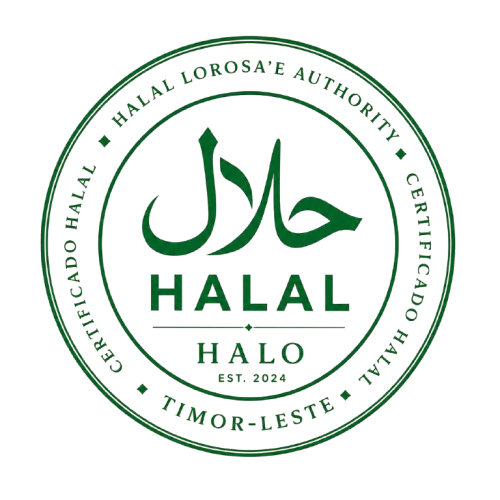
Each product and service, upon approval by the halal competent authority, may be marked with the halal certification logo of HALO Timor-Leste, provided the product and service conform to the requirements of this standard. The HALO certification mark shall not be used on any product or service that has not been approved by HALO, nor in any manner that is misleading.
Annex A (normative)
Method of sertu for najs al-mughallazah ↑ Top
A1 General requirements
The najs, whether visible ('ainiah) or invisible (hukmiah — disappeared or dried up, etc.), shall be cleansed. To cleanse najs:
- it is required to wash seven times, one of which shall be water mixed with soil;
- the first wash shall be to clear the existence of najs, even if a few washes are needed; the water from the first cleaning shall not remain behind, and the next wash shall be counted as the second wash;
- the amount of soil used is just enough to make a suspension; and
- the usage of a product containing soil is permitted.
A2 Conditions of the soil
The conditions of the soil are:
- free from najs; and
- not musta'mal soil [which had been used for dry ablution (tayammum)], except after being subject to heavy rain.
A3 Conditions of the water
The conditions of the water shall be:
- natural (mutlaq);
- not musta'mal; and
- free from najs.
Bibliography ↑ Top
- MS 2393, Islamic and halal principles — Definitions and interpretations on terminology.
- MS 1480, Food safety according to hazard analysis and critical control point (HACCP) system.
- MS 1514, Good manufacturing practice (GMP) for food.
- MS 1900, Shariah-based quality management systems — Requirements with guidance.
- Codex Alimentarius — General Guidelines for Use of the Term "Halal" (CAC/GL 24-1997).
- HALO Timor-Leste — Manual procedure of halal certification.
- HALO Timor-Leste — Protocol for halal meat and poultry production.
- HALO Timor-Leste — Guideline on sertu from the Islamic perspective.
- Applicable food safety, food hygiene and consumer protection legislation currently in force in the Democratic Republic of Timor-Leste.